

How to Choose the Best Bathroom Door: Materials, Sizing, and Style Guide
Replacing a bathroom door presents unique challenges compared to the rest of the home. Because the bathroom is often the smallest room in the house—and the one with the highest humidity—you need a door that balances durability, privacy, and space-saving functionality.
Here are the essential tips for selecting a bathroom door that blends high-end aesthetics with everyday performance.
1. Selecting the Right Material for Humidity
Bathrooms experience frequent temperature shifts and moisture. While basic hollow-core doors can warp over time, you have several high-quality options:
Solid-Core Doors: These are the gold standard for bathrooms. They provide the look and weight of real wood but are engineered to resist the "swelling" caused by humidity. Plus, they offer superior soundproofing for privacy.
Finished vs. Unfinished: To ensure a long lifespan and protect your warranty, it is best to select a pre-painted or pre-stained door. A factory-applied finish creates a professional moisture barrier that is much more effective than DIY painting.
Fiberglass & Steel: These are durable options, often embossed with wood-grain textures, that are virtually immune to moisture damage.
2. Mastering the "Swing" in Tight Spaces
In a confined bathroom, the "swing path" of the door is everything. A door should open completely without hitting cabinets, vanities, or mirrors.
The Direction: Determine if you need a "right-hand" or "left-hand" swing before ordering.
The Space-Saver: If a standard swinging door feels too cramped, consider a pocket door or an interior sliding barn door. These are perfect for small powder rooms where every inch of floor space counts.

3. Pre-Hung vs. Slab Doors
Pre-Hung Units: This is a door that comes already hanging in its own frame. These are the easiest to install if you are doing a full renovation or if your existing door frame is damaged or out of square.
Slab Doors: If your current frame is in perfect condition, you can purchase just the "slab" (the door itself). This requires more precision in hanging but saves you from having to tear out the decorative trim around the door.
4. Precision Measuring
To get a perfect fit, you must measure the "rough opening" of the doorway:
The 1/8-Inch Rule: Generally, the door slab should be approximately 1/8-inch smaller than the frame opening on all sides to allow for smooth operation without sticking.
Wall Thickness: If buying a pre-hung unit, ensure the frame width (jamb) matches the thickness of your wall (usually 4 9/16" or 6 9/16" depending on your home's construction).
5. Style and Design Trends
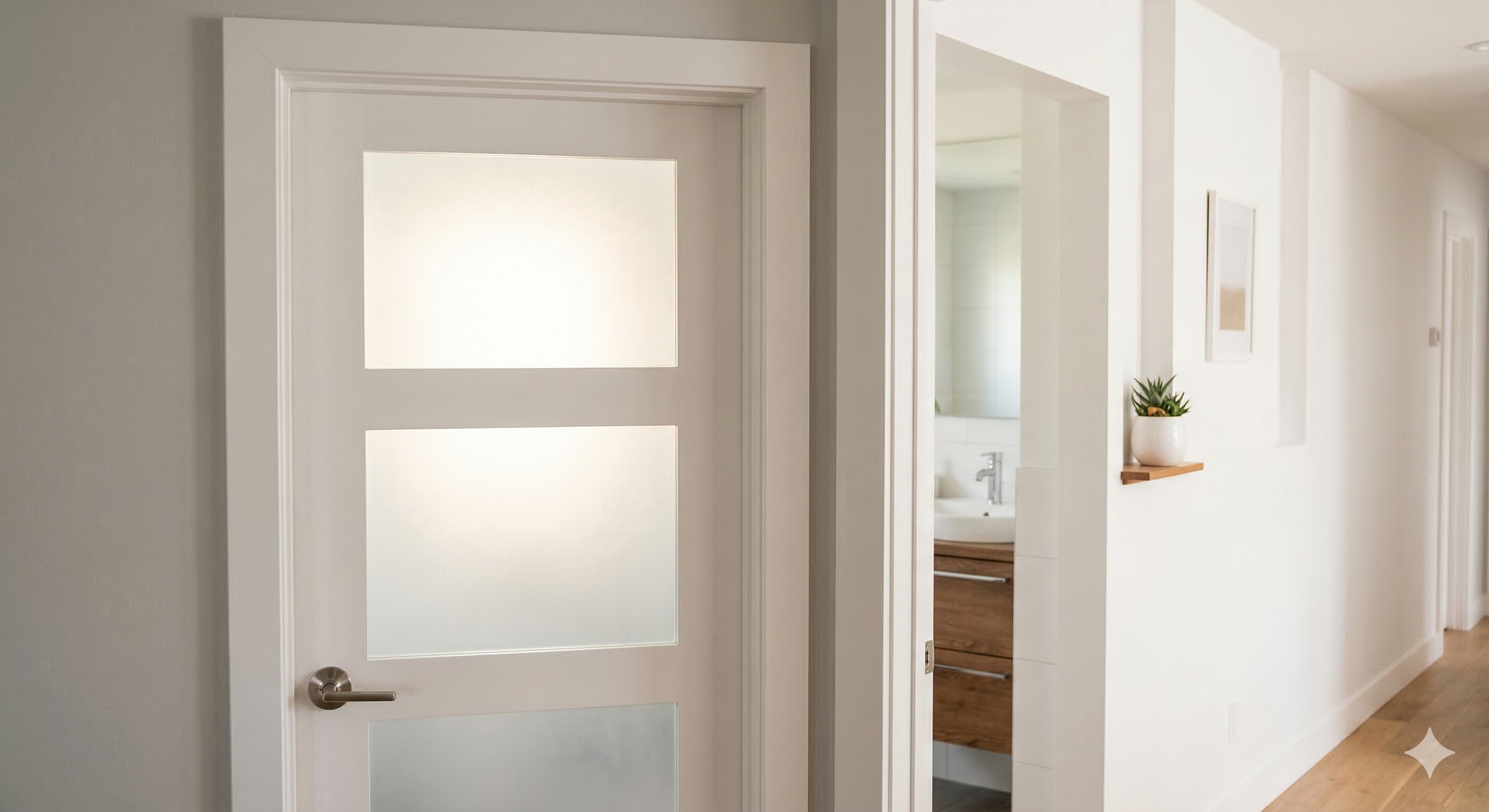
Your bathroom door doesn't have to be boring. While a six-panel door is a classic choice, modern homes are shifting toward shaker-style flat panels or even doors with frosted glass inserts. Frosted glass is a brilliant bathroom hack—it allows natural light to flow into a dark hallway while maintaining 100% privacy.
Upgrade Your Bathroom’s Privacy and Style
A bathroom door is the most-used door in the house. Why settle for a flimsy, hollow-core door that lets noise through? Investing in a high-quality, solid-core door increases your home's value and your daily comfort.
Ready to find the perfect fit? Browse our Bathroom & Interior Door Gallery or call us for a Professional In-Home Measurement to ensure a perfect installation.